Research Highlight — Nature Communications (2025)
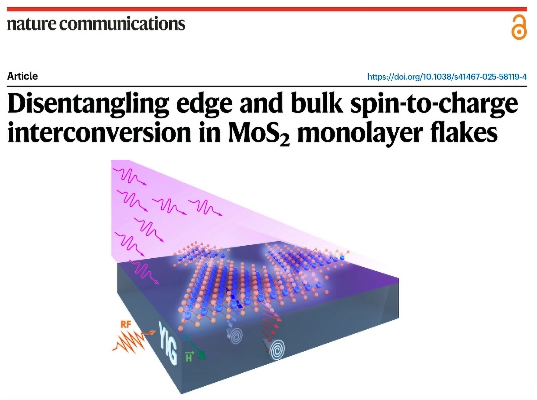
We investigate the process of spin current injection into an atomic layer of MoS₂, which takes the shape of small triangles, and how the conversion of spin current into charge current occurs differently at the center versus the edge — the former exhibiting semiconductor character and the latter metallic character.
Spin-to-charge conversion in MoS₂ monolayers results from two simultaneous channels: (i) the semiconductor contribution associated with the flake area, attributed to the inverse Rashba–Edelstein effect (IREE), and (ii) the metallic contribution associated with the edges, likely related to the spin Hall effect (SHE). These channels have opposite signs and compete, leading to a compensation point where contributions cancel out.
The work demonstrates that light enables unprecedented control of spin injection — amplifying, attenuating, or switching spin conversion — positioning this as a milestone for opto-spintronics at room temperature.